
Professional Development Is Only the Beginning (Not the Goal)
As the calendar turns to August, school leaders everywhere begin making decisions about professional development. Conference registrations are finalized. Opening in-service agendas start to take shape. Faculty workshops are added to the calendar with the hope that they will strengthen teaching and improve student learning.
Learning Experiences Matter
For much of my career, this is exactly how I thought about professional development. It was all about the events that I attended, and the value was based on the extent that it applied in “my classroom.” I still believe those learning experiences matter. Many of the ideas that have shaped my own teaching came from a conference session or a conversation with another educator.
Over time, however, I realized I had been treating professional development as the destination rather than the starting point. A great workshop doesn't improve a school. It simply creates the opportunity for improvement.
The real work begins after teachers return to school. That's when faculties wrestle with new ideas together, develop a shared understanding of what those ideas should look like in their classrooms, and translate that understanding into more consistent practice for students.
Shared Understanding Changes Schools
Once that destination is clear, conferences, workshops, and online courses all take on a different purpose. Rather than becoming isolated events throughout the year, they become intentionally selected learning experiences that help move the faculty toward a common goal.
At Blueprint Schools, we've found it helpful to think about professional learning as a progression.
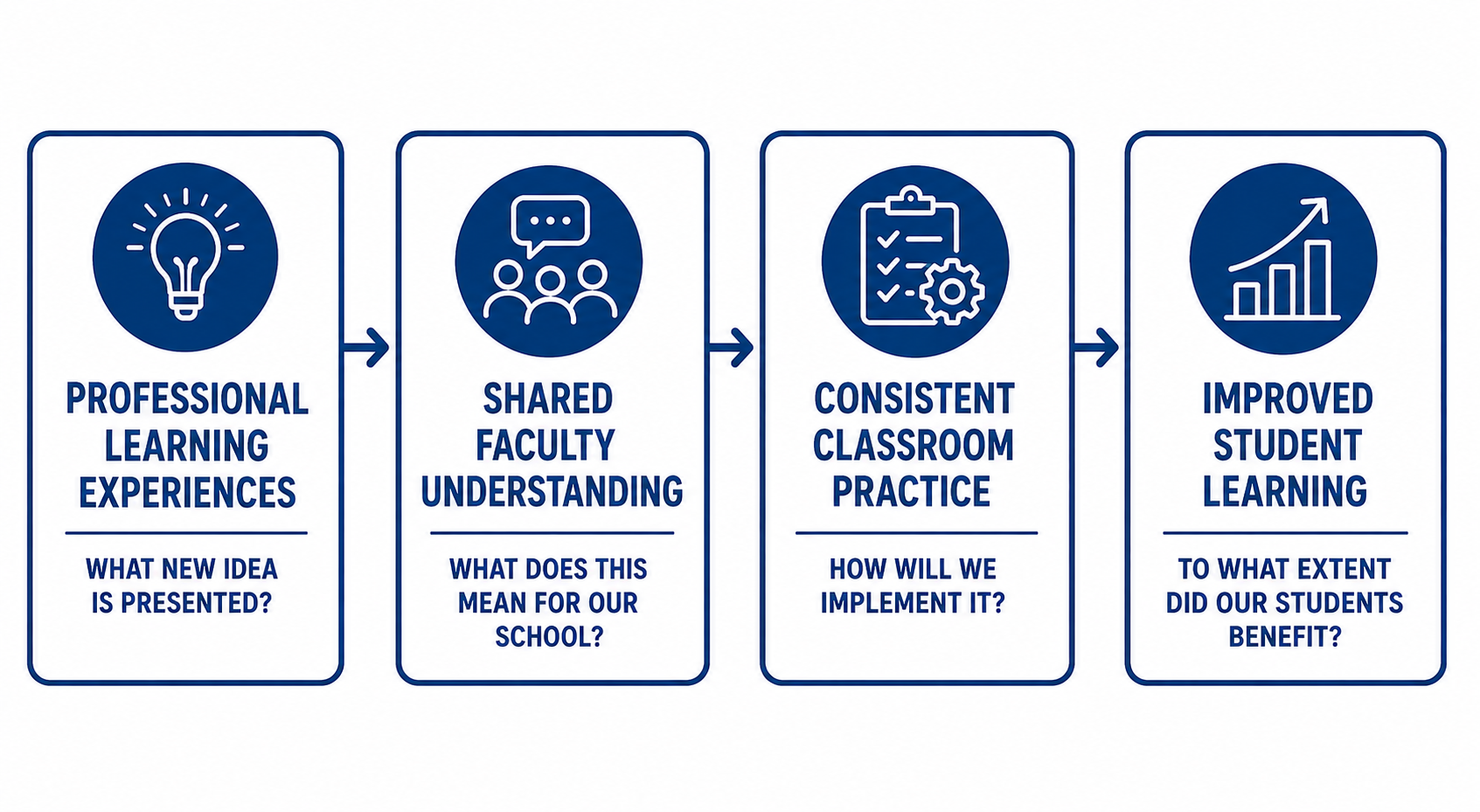
Every conference, workshop, coaching conversation, and online course should have the same purpose: moving a faculty one step further along this progression.And research on effective professional learning supports this approach, consistently finding that professional development has the greatest impact when it is collaborative, sustained over time, and connected to teachers' daily work (Darling-Hammond, Hyler, & Gardner, 2017). Read the report here.
AI Is the Opportunity
Over the past year, I've had the privilege of speaking with Christian school leaders across the country, and while every school's situation is different, the questions are remarkably similar. Leaders aren't simply asking which AI tools teachers should use. They're asking when AI supports meaningful learning, when it replaces important thinking, and how it can most wisely be implemented in schools.
Notice that none of those questions are really about technology. They are questions about teaching, learning, and the experiences we want students to have. Because of that, they cannot be answered by individual teachers working in isolation; they require an entire faculty to develop a shared understanding.
Without a shared understanding, every teacher is left to answer them independently, and students experience a different set of expectations every time they walk into a new classroom.
That's exactly why we designed our AI professional learning differently.
The AI Blueprint Summitwas designed to help school leadership teams build that shared understanding before implementation begins. Over two days, leaders clarify how AI aligns with their school's mission, educational philosophy, and vision for student learning before making decisions about classroom implementation.
The AI Blueprint for Teachers supplements and extends that work to the faculty. Rather than focusing primarily on how to use AI, the course helps teachers develop a shared understanding of when AI strengthens learning and when it doesn't. Through authentic classroom scenarios and collaborative discussion, faculties develop common language and common expectations that can be carried into conversations and everyday classroom practice.
Together, the Summit and the course were intentionally designed to support the same progression outlined above. They move schools beyond simply introducing new information and toward creating the shared understanding that leads to consistent practice and better learning for students.
Start With the Destination
As you finalize your professional development plans this August, resist the temptation to begin with your calendar. Instead, begin with your destination.
Ask yourself, "What shared understanding do we want our faculty to develop this year?"
If you're like many school leaders, AI is already on your professional development calendar in one form or another.
Not because AI is the newest educational trend, but because few topics will influence teaching and learning more significantly over the next several years. Whether schools embrace AI enthusiastically or cautiously, students deserve a faculty that shares a common understanding of when AI supports meaningful learning, when it doesn't, and how those decisions reflect the school's mission and educational philosophy.
That's the reason we created both the AI Blueprint Summit and The AI Blueprint for Teachers Course. They aren't simply opportunities to learn about AI. They're designed to help leadership teams and faculties develop the shared understanding that meaningful implementation requires.
Because in the end, professional development begins the conversation. Shared understanding changes the classroom.
Ready to Build Your Professional Learning Plan?
Set up a call with Ryan by emailing him at ryan.kirchoff@blueprint-schools.com. He’d be happy to walk you through our professional development options, including upcoming AI Blueprint Summits and the AI Blueprint for Teachers Course, and help you build a plan that fits your school.
